
Pharmacy Continuity During Leadership Transitions
June 17, 2026
Moving to a Higher Level of Care
June 18, 2026
Pharmacy Consistency is an Operational KPI (Not Just a Clinical One)
Download to share or read later: Pharmacy Consistency is an Operational KPI
In senior living, pharmacy is often evaluated through a clinical lens — and that’s appropriate. Medication safety, adherence, and resident outcomes matter. But as operational pressures continue to mount, there is a strong case for evaluating pharmacy consistency as an operational metric as well.
For VPs of Operations and Clinical Services managing multi-community portfolios, pharmacy performance affects staffing efficiency, caregiver bandwidth, and the ability to maintain consistent standards across communities. In an environment where labor is the industry’s most constrained resource, any workflow that unnecessarily consumes staff time deserves to be measured and managed.
The medication pass is one of those workflows where pharmacy consistency is an operational KPI.
The scale of the task is often underestimated for multi-community operators; variability multiplies the problem.
Assisted living and memory care residents have complex, high-volume medication needs. Data published by August Health reports an average of 15 medications per resident, with more than one-third having 15 or more when scheduled and PRN medications are included. The medication pass is not a simple task among other duties. It is a high-stakes, time-intensive workflow executed multiple times each day across every community.
When the pharmacy supporting that workflow is inconsistent — delayed fills, variable packaging, unclear communication — the burden lands directly on frontline staff. And in today’s labor environment, that burden compounds quickly.
The cost often doesn’t show up where you expect it.
In assisted living, pharmacy costs are frequently embedded in residents’ prescription benefits rather than appearing as a clear community line item. So when pharmacy performance is poor, the cost may not show up as a pharmacy fee.
Instead, it shows up as staff overtime, supervisor escalations, caregiver hours diverted away from residents, and regional leader time spent troubleshooting. The operational cost of inconsistency is real — it’s just easy to miss until it’s measured.
For multi-community operators, variability multiplies the problem.
What might be absorbed as a one-community inconvenience becomes a systemic challenge at scale. When workflows differ across communities — packaging formats, delivery windows, check-in processes — regional teams lose the ability to establish consistent standards and benchmark what good looks like.
It has been reported that over 200,000 older adults are hospitalized annually due to adverse drug events, and that a majority of those cases are considered preventable. Prevention depends on standardized, predictable workflows that caregivers can execute reliably — not workflows they need to adapt to from shift to shift or community to community.
What to Track: A Practical Operational Approach
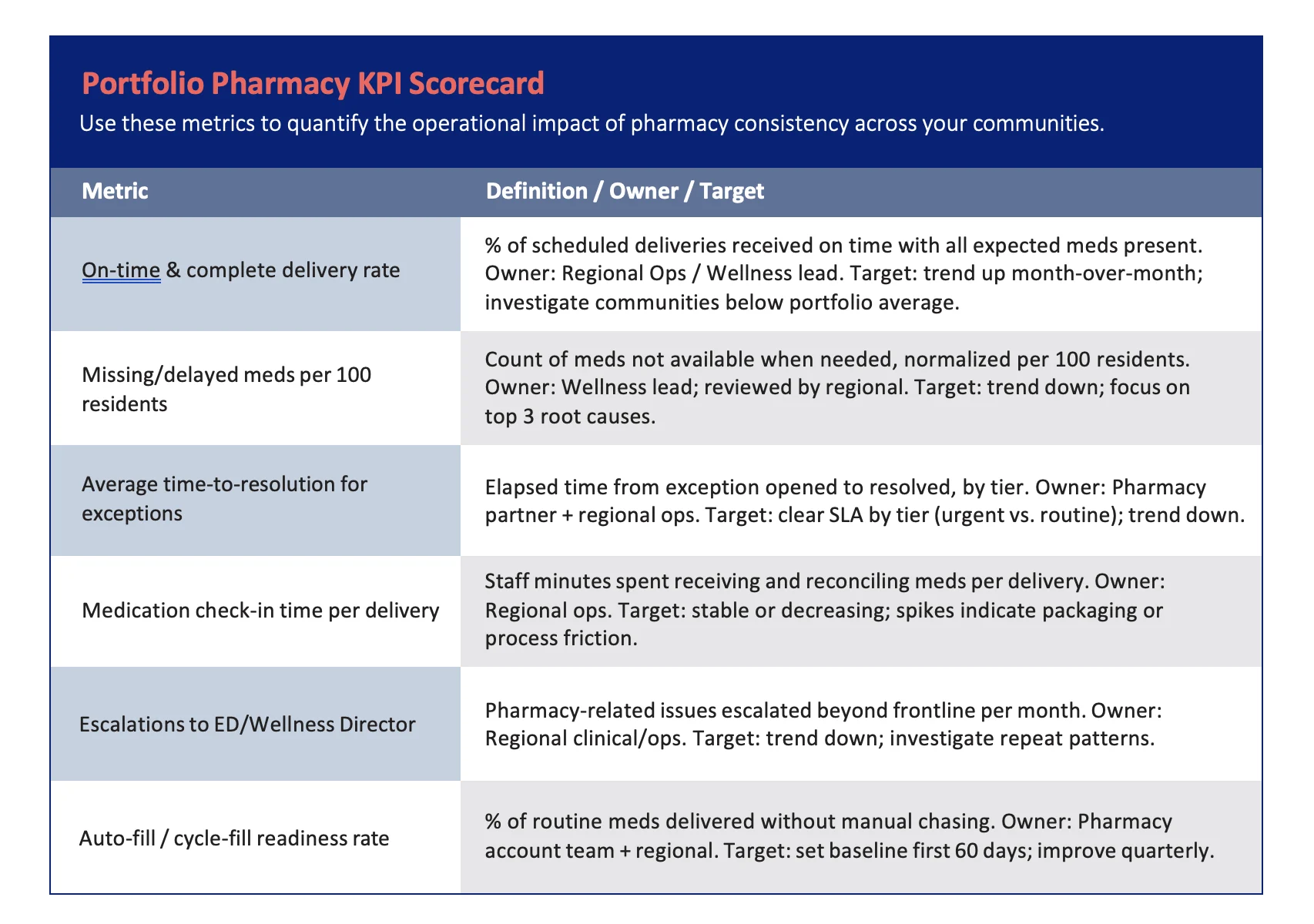
The goal is not to turn pharmacy into a spreadsheet exercise. The goal is to identify where inconsistency is creating avoidable workload — and then eliminate it. Below is a simple scorecard framework for portfolio-wide use.
The Connection to Caregiver Retention
Consistency is also a retention lever. High-burden workflows filled with exceptions, rework, and escalations wear teams down. When medication management runs predictably, caregivers spend more time on resident care and less time on administrative firefighting.
Argentum projects the senior living industry will need millions of additional workers over the coming decades. Operators can’t hire their way out of workflow friction. Reducing avoidable burden in medication management is one practical way to protect the staff you already have.
Pharmacy should remain clinically accountable — but it should also be operationally measurable. Leaders who treat pharmacy consistency as an operational KPI are better positioned to protect caregiver time, standardize performance across communities, and reduce the hidden cost of variability at portfolio scale.